This story begins with Ishaan Daga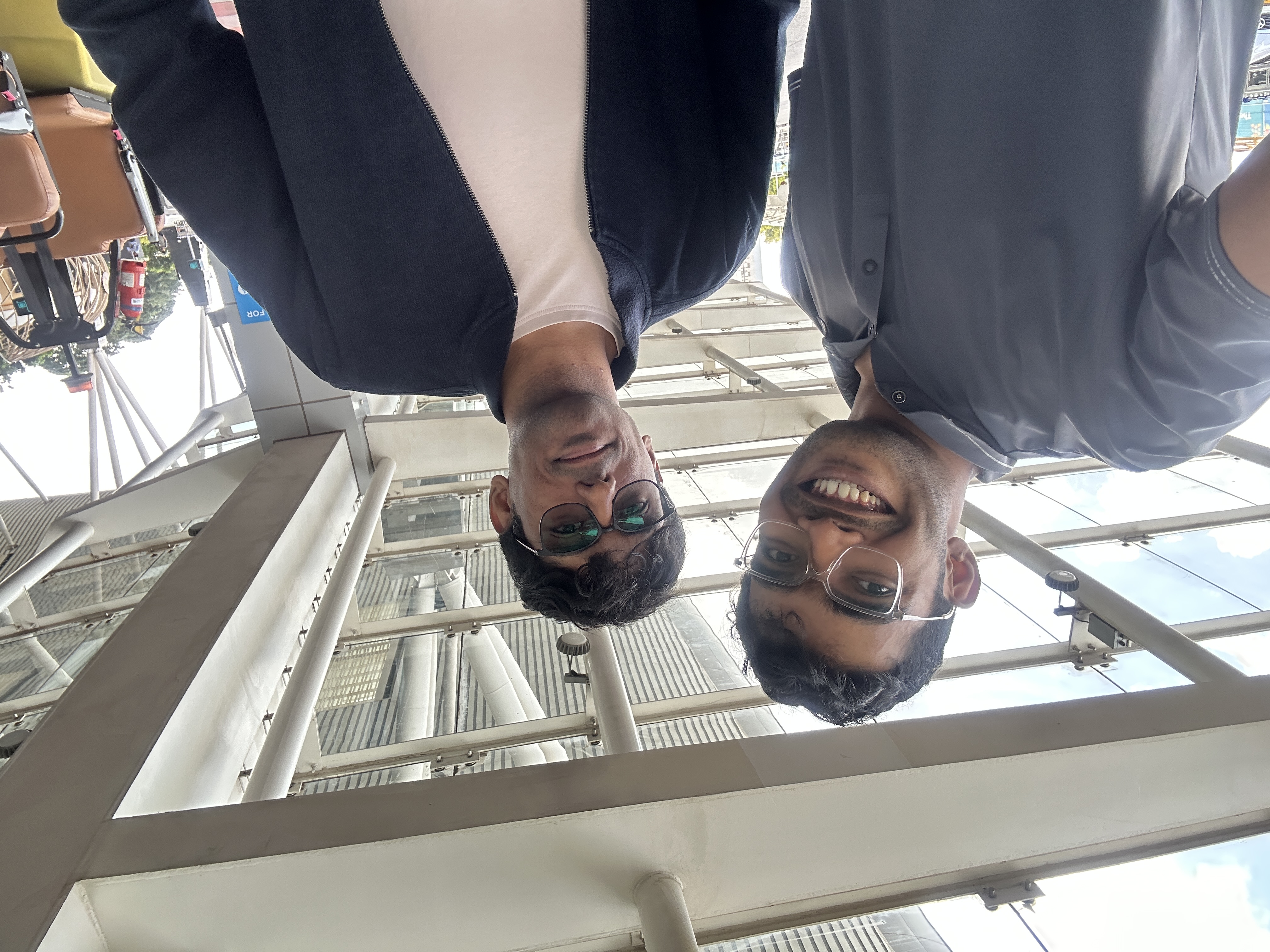 Ishan Dagaperson · read the story and an airport.
I had met Ishaan at a reception, left my bag there and travelled with him to the airport even though I had known him for barely a few minutes. After I dropped him, he connected me with Hemanth and said something close to: you two will love this.
He was right.
It took us a couple of days to get the meeting together. Then Hemanth took me inside Zo House Zo House, Bangaloreplace · opens in a new tab in Bangalore. It is not a normal coworking space you casually walk into. Founder members use a Zo World membership to unlock it; visitors need an invitation or a confirmed booking.
We sat down, switched on the mic and began with the usual introductions.
Mine was the usual mess: I build companies, make videos and keep trying things which might go kaboom.
His introduction was a banger: he works at SpaceX SpaceXcompany · opens in a new tab.
You might think that is the epitome of the story. It is not even where his story starts.
Iron man, except the cave was his house
Hemanth comes from a humble background. When he was thirteen and studying in the eighth standard, his father’s HTCHTCcompany · opens in a new tab phone stopped working after they tried modifying its software.
The phone stopped turning on.
They took it to the official HTCHTCcompany · opens in a new tab service centre. The answer was simple: this is dead. Throw it away and buy another one.
So the dead phone came home, and Hemanth kept staring at it.
He opened a laptop, wandered through random corners of the internet, broke more things and eventually built and flashed a custom operating system onto it.
The phone turned on.
“I did something the HTCHTCcompany · opens in a new tab service guys said they couldn't.”
It is the closest real-life version of Iron Man building a suit in a cave with a box of scraps. The official people had the tools, the manuals and the logo above the door. The child at home had curiosity and enough stubbornness to keep trying.
Imagine what that does to your brain. An adult tells you something is impossible. You refuse the answer and make it work anyway.
That is a dangerous amount of confidence to accidentally hand a curious kid.
Then the story kept going upwards
Hemanth did not know that fixing the phone would require him to understand Java. He did not have a course or someone patiently teaching him.
He knew one command that could print something. So he inserted it into a line, pressed a button and checked whether anything happened. Then he moved it and tried again.
“Something is happening. Something is not happening. Something is happening. Something is not happening.”
He learned through trial and error so slowly that trial and error itself became the skill. Once he understood what a programming language was doing underneath, learning the next one became dramatically easier.
The repaired phone became Firehound, an Android operating-system community he started with a friend while he was still in school. They gave old phones newer software so people could continue using hardware that manufacturers had abandoned.
That community put him in rooms with people across countries who were reverse-engineering hardware and doing other sweaty technical shit I only partly understand.
Later came a cyber Olympiad, open-source work, hackathons and his first freelance project: a contact-tracing application that he says was eventually used by a government.
He did not even realize the work was paid until someone asked for his bank details.
“For what? You get money for this?”
That first small cheque changed the question from “can I build this?” to “if I can build this, why should I always build it for someone else?”
Then came a much larger open-source cheque, a global PostmanPostmancompany · opens in a new tab hackathon and the Apple products he had spent years obsessing over.
I understand this level of stupidity very well. Once an obsession enters your head, the object stops being an object. It becomes proof that you can make reality move.
A race of turtles is still a race
Hemanth eventually joined CiscoCiscocompany · opens in a new tab. During his internship, he took a feature from scratch to production and earned an engineering role normally meant for someone with more experience.
Then he ran into the part he hated.
A code change he made today could take months to reach production. Approvals, processes and responsibility moved through the company one table at a time.
I asked the obvious question. How can a technology company stay slow?
His answer was that the clients were slow too.
It was a race of turtles. There was no rabbit in the market forcing anyone to become one.
He wanted to act now, watch the action fail now and learn now. So he left the corporate path and moved towards startups.
That is where our brains started colliding.
He asked for my roughest sheet of paper
I told Hemanth what I am trying to do with Temporary PerspectiveTemporary Perspectiveventure · opens in a new tab.
I do not want to remain a company that only makes beautiful videos. I want to become the distribution layer for technology companies: launch films, founder content, daily media and eventually a system that can understand my thoughts before a shoot and decide what should become a video.
I told him I want to stack businesses. Keep PivotingKeep Pivotingventure · opens in a new tab brings revenue and relationships into Temporary PerspectiveTemporary Perspectiveventure · opens in a new tab. Temporary PerspectiveTemporary Perspectiveventure · opens in a new tab builds distribution. The distribution makes the next product cheaper to launch.
Not long ago, he said he would have called this stupid and told me to focus on one company.
Today, with the cost of technical execution collapsing, he thinks I might be onto something.
But he did not stop at “crazy idea, bro.”
He asked me for the roughest sheet of paper I had.
Then he drew the wedge.
Go where companies have recently received money and urgently need distribution. Make the launch video. Use that work to enter the company. Then become the centre through which those companies find customers, content and each other.
His example was a freshly funded startup batch. Even if only a small percentage needs a launch package, that is a serious market. The video is only the penetration layer. The real business is the distribution network built after it.
For the first time, the media outlet, the video agency and my obsession with meeting people looked like one system instead of three different symptoms of ADHD.
What I can build from this immediately
I do not want this to become one more conversation where two founders say brilliant things, feel intelligent and then go home unchanged.
So I pulled a few experiments out of the conversation.
- Follow the money. Maintain a live list of recently funded technology companies. They have a launch deadline, a distribution problem and capital that has to be deployed.
- Use video as the door, not the entire house. Sell the launch film first. Once we understand the founder, product and audience, expand into recurring founder content and distribution.
- Build the editor before the camera turns on. Feed my notebook and meeting transcripts into a system that extracts the strongest hook, metaphor and argument, then produces the missing shot list. We should shoot only what the edit actually requires.
- Make one engine win. Temporary PerspectiveTemporary Perspectiveventure · opens in a new tab needs to become the reliable cash and distribution engine before I use it to pull more ventures behind it.
None of these is a grand long-term plan. Each can be tested quickly. That is exactly why I like them.
The one horse still matters
Hemanth did disagree with me on one important thing.
You cannot create an ecosystem from nothing. Tata could build multiple businesses because one engine created enough profit to fund the next one. You still need one horse that wins.
His advice was not to take venture money simply because it is available. If I want the freedom to keep experimenting and stacking companies, capital can turn into a long set of handcuffs around one idea.
His rule for me was intentionally extreme: protect the freedom to pivot unless the opportunity can genuinely become enormous or the business is at the edge of dying.
I do not know if I agree with every edge of the rule. I agree with the mechanism.
Money is useful when it multiplies a direction you are willing to remain inside. If you are still someone who needs to Keep PivotingKeep Pivotingventure · opens in a new tab, money can freeze the wrong version of you.
Why I am writing about him
Hemanth is obviously technically intelligent. But the job title was still the least useful part of meeting him.
He can take a dead phone, a corporate approval chain, a poker stack, a launch-video agency and a hundred-company dream and keep asking the same question: what is the underlying system?
He did not give me motivation. He gave me a wedge, a warning and a sheet of paper I can act on.
We are meeting again on Tuesday to build, not merely continue the conversation.
I am carrying the rough notebook. This time I also want a working prototype before either of us leaves.
And whenever Hemanth decides to build his own startup, I want to see what happens. A person who can ignore an official service centre, revive the supposedly dead thing and keep climbing from there is not someone you casually bet against.
I would love to be close enough to help when that story begins.